
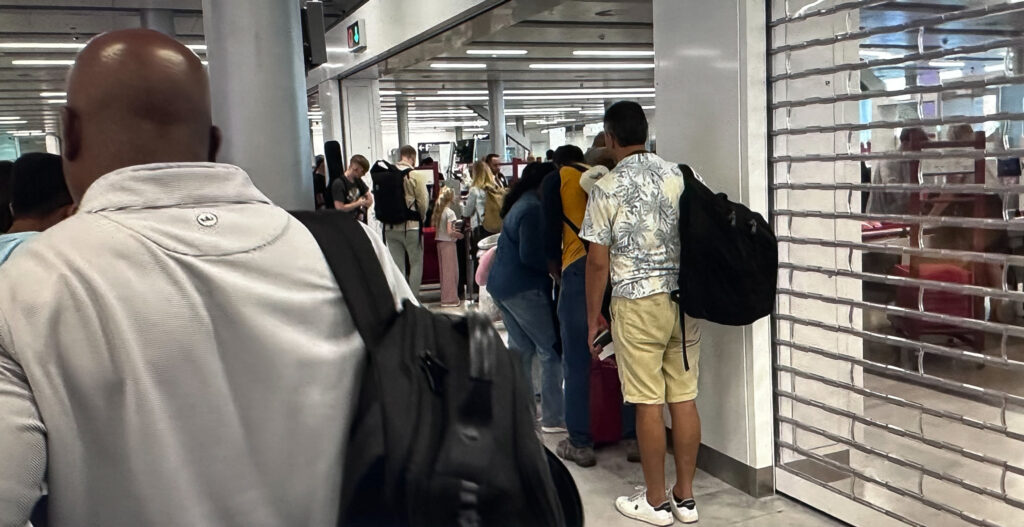
If you fly often enough, something will eventually go wrong. A delay or a cancellation. A missed connection.
It is not a matter of if — it is a matter of when. Weather shifts. Aircraft require maintenance. Crews reach duty limits. Air traffic control slows departures. These realities are part of modern air travel.
The difference between a stressful disaster and a manageable inconvenience is preparation — and how you respond when it happens. You cannot control the delay, but you can control yourself.
When Your Flight Is Delayed
If your departure time begins to slip, resist the urge to immediately crowd the gate desk. Instead:
- Open your airline’s app immediately.
- Check where your aircraft is coming from.
- Monitor gate changes and watch for updates before standing in line.
- Stay near the boarding area as departure time approaches.
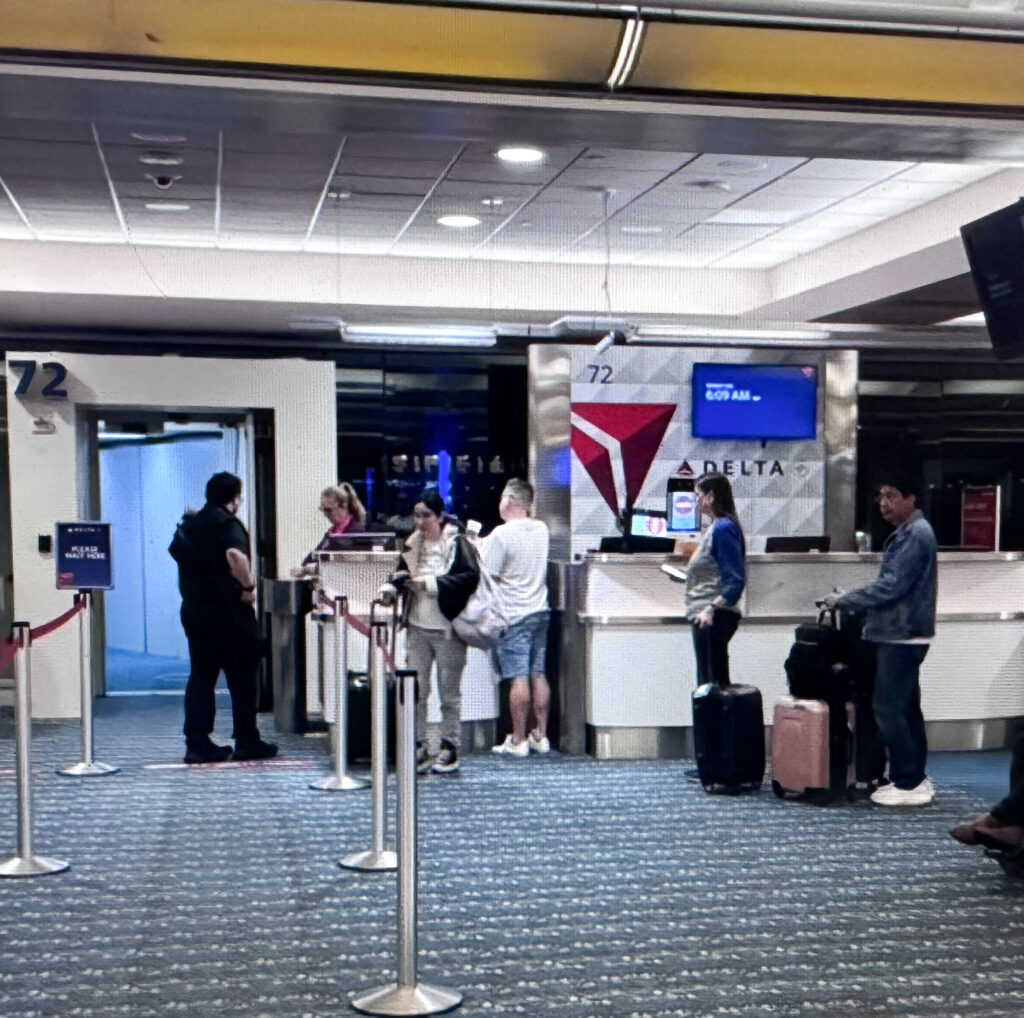 The loudest person at the gate rarely gets helped first. Gate agents are managing dozens — sometimes hundreds — of affected passengers. Calm, informed travelers are easier to assist.
In the United States, there is no automatic cash compensation simply because a flight is delayed. If the delay becomes significant and you choose not to travel, you are entitled to a refund — even on a non-refundable ticket.
If you choose to travel, the airline will typically rebook you. Meal or hotel vouchers may be offered for significant overnight delays, especially when the delay is within the airline’s control. Weather and air traffic control restrictions are generally considered outside the airline’s control.
When a Flight Is Cancelled
Cancellations are more disruptive, but the response strategy is similar. If your flight is cancelled:
- Open the airline app immediately.
- Look for automatic rebooking.
- Get in line — but also call customer service.
- If you have lounge access, go there.
- Before speaking to an agent, look up alternative routing options yourself.
When you reach an agent, it helps tremendously if you can calmly say: “I see availability on the 4:20 flight through Atlanta. Would that be an option?” Prepared passengers are easier to help.
If the airline cancels your flight and you choose not to travel, you are entitled to a full refund.
Overbooking, Volunteers, and Compensation
Airlines routinely oversell flights.
They do this based on historical no-show rates. Most of the time, the numbers work. Occasionally, they do not. When more passengers show up than there are seats available, the airline first asks for volunteers to give up their seat in exchange for compensation.
This is where many travelers misunderstand their rights.
Volunteering Is a Negotiation
If you volunteer, you are negotiating directly with the airline. They may offer:
- Travel vouchers
- Gift cards
- Hotel and meal accommodations
- Rebooking on a later flight
Airlines often begin with a lower offer and increase it if no one accepts. Some passengers wait for the amount to rise. That can work — but it is a gamble. Someone else may accept the offer before it increases further.
Once you accept a voluntary offer, you generally waive the federal minimum compensation protections that apply to involuntary denied boarding. Know your flexibility before volunteering.
If you absolutely must arrive that day, volunteering may not be wise.
If You Are Involuntarily Denied Boarding (U.S. Law)
 If no one volunteers and the airline denies you boarding against your will — and you had a confirmed reservation, checked in on time, and arrived at the gate as required — federal regulations require compensation.
Under current U.S. Department of Transportation rules:
- Arrival delay less than 1 hour → No compensation
- Arrival delay 1–2 hours (domestic) or 1–4 hours (international from U.S.) →
200% of your one-way fare, up to $1,075 - Arrival delay over 2 hours (domestic) or over 4 hours (international from U.S.) →
400% of your one-way fare, up to $2,150
This compensation must be offered in cash, check, or another immediately negotiable form — not merely a travel voucher. These are minimum amounts required by law. It pays to know your rights. To see all of your rights for being bumped or involuntarily denied boarding, click here for the official DOT Rules on Involuntary Bumping.
Airlines are free to offer more — but not less — in an involuntary situation. One of the simplest ways to reduce your risk of involuntary bumping is to check in online as soon as check-in opens — typically 24 hours before departure. When airlines must decide which passengers to deny boarding, check-in time can be one factor considered, especially among passengers in the same fare class.
UK & European Union Flights
 If you are flying from the United Kingdom or the European Union — or on certain carriers arriving there — passenger protection laws may provide fixed compensation when arrival is delayed more than three hours and the disruption is within the airline’s control.
Compensation can range roughly from €250 to €600 (or the UK equivalent), depending on distance and delay length. Extraordinary circumstances, such as weather or air traffic control restrictions, are excluded.
To see your specific rights, click here for UK Civil Aviation Authority – post Brexit Rules and EU Regulation EC 261/2004.
Missed Connections: A Practical Lesson
I once returned from England with a connection in Minneapolis after a long overnight flight.
We departed Europe late due to air traffic control restrictions. By the time we landed, I had a tight connection. Even though I was one of the first off the aircraft, my international arrival gate was at one end of the concourse and my domestic connection was at the far opposite end. It was a long walk — even using the tram.
I arrived at my gate three minutes after boarding had closed. The door was shut. At that moment, there was nothing to argue about. The aircraft was leaving. Instead of panicking, I opened the airline app, located the nearest Delta lounge, and calmly explained the situation. I was rebooked on a later flight and eventually made it home.
Stressful? Yes. Catastrophic? No. The lesson was simple: build margin into your connections — especially international to domestic connections at large hub airports.
Terminals can be enormous. Immigration can take time. Boarding doors close earlier than many travelers realize. Margin matters.
The Mindset That Makes Travel Easier
If you travel often enough, you will experience delays.
You will sit on an aircraft waiting for departure. You may miss a connection, or worse, have to spend an unexpected night in a hotel. This is part of air travel. What matters most is how you respond.
Panic does not reopen boarding doors. Yelling does not make aircraft arrive sooner.
Preparation helps. Patience definitely helps. Knowing your rights is essential. But staying calm helps most of all.
Build margin into your schedule. Keep essential items in your carry-on. Expect that something may not go exactly as planned. Travel is not about perfection. It is about preparation — and composure when plans shift.

Buddy and Jordan