
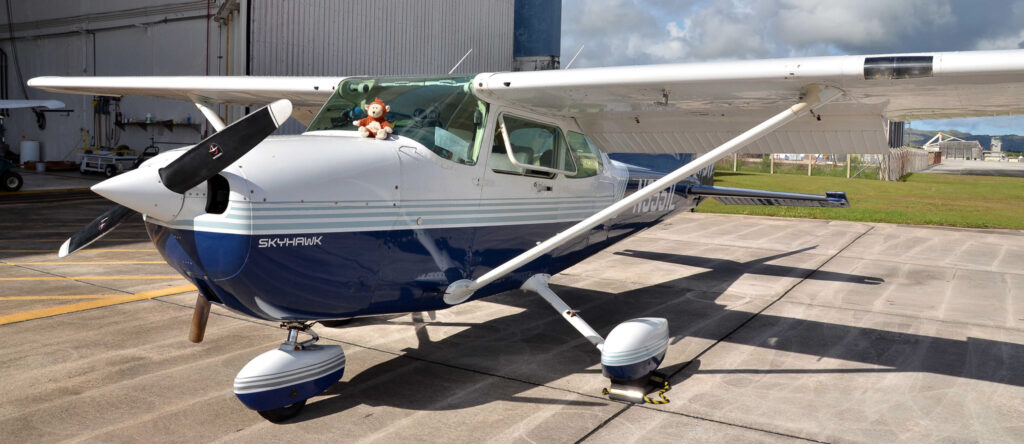
There is a moment, shortly after takeoff in a small single-engine aircraft, when the ground falls away beneath you and the world opens up in every direction. No cabin walls blocking the view. No rows of seats between you and the horizon. Just you, the aircraft, the sky, and a sense of freedom that is genuinely difficult to describe to someone who hasn’t experienced it.
I’ve been a licensed private pilot since December 7th, 2010. I have over 600 hours of flight time, including search and rescue missions with Civil Air Patrol and orientation flights for more than 160 cadets. I’ve rented planes in Alaska, Salt Lake City, and everywhere in between, just to see what the local area looks like from the air.


This post won’t teach you to fly. But it might give you a sense of what general aviation actually feels like — and why, once you’ve experienced it, the sky is never quite the same again.
How I Got Here: Put Up or Shut Up
I loved aviation from the time I was a small child. But life has a way of filling up with other things.
I joined the Army at seventeen. Constant moves, college, law school — there was never enough stability in one place to commit to flying lessons. For decades, learning to fly was something I always meant to do. Something I’d get to eventually.
In 2007, I was stationed in Hawaii. For the first time in a long time, I had both the time and the stability to make good on a lifelong promise to myself. I decided it was time to put up or shut up.
At the end of June 2010, at the age of forty-nine, I began flying lessons at Honolulu International Airport.
Learning to Fly at One of the Busiest Airports in the Pacific
Most student pilots begin their training at small, uncontrolled airports — fields with minimal traffic, no control tower, and plenty of room to make mistakes without consequence. It’s the sensible approach. Hold my beer.
I chose Honolulu International Airport, a Class B facility — the same designation as LAX, JFK, and O’Hare. Busy commercial traffic, strict airspace procedures, constant radio communication with controllers. Not the typical starting point for a student pilot.


But it was where I was, and I committed fully. Two or three lessons a week after work, plus weekends. Learning to fly requires consistency — if you only fly once a week, you lose ground between lessons faster than you gain it. I was determined not to let that happen.
Three Dates That Defined My Training
The timeline of my pilot’s license is something I could not have planned if I tried.
On September 2nd, 2010 — the 65th anniversary of VJ Day, the formal end of World War II, the day Japan surrendered aboard the USS Missouri, which sits anchored in Pearl Harbor — my instructor and I flew out to West Oahu for my supervised solo. He got out of the plane, stepped back, and watched me execute three takeoffs and landings entirely on my own for the first time. The weight of that date was not lost on me.
Nine days later, on September 11th, 2010, I completed my unsupervised solo flight. Nine years after one of the darkest days in American aviation history, I flew alone for the first time.
And on December 7th, 2010 — Pearl Harbor Day, the 69th anniversary of the attack that brought America into the Second World War — I passed my FAA checkride and earned my private pilot certificate.
 The most memorable moment of the entire journey came on that final approach into Honolulu. As I descended toward the runway, I flew directly over the USS Arizona Memorial and the USS Missouri sitting in the harbor below. The same harbor. The same ships. On December 7th.
I had started this journey in June on an island that holds more American military history than almost any place on earth. I ended it six months later, on the most significant date that island knows, looking down at the place where so much of that history happened.
Some moments you plan. Some moments find you.
What a Typical Flight Feels Like
People who have only flown commercially often have a certain image of what flying a small plane must be like — terrifying, cramped, loud, dangerous. The reality is more nuanced, and for most flights, more peaceful than you’d expect.
A typical flight in a Cessna 172 or 182 begins with a preflight inspection — a careful walkaround of the aircraft checking control surfaces, fuel levels, oil, tires, and a dozen other items on a checklist that exists for very good reasons. This is not optional, and no experienced pilot skips it. You are the captain, the first officer, the flight engineer, and the mechanic all at once.
Then you’re in the cockpit. The Cessna 172 and 182 are four-seat, single-engine aircraft — a high-wing design that gives you excellent visibility of the ground below. The instrument panel is considerably simpler than a commercial aircraft but requires the same attention and discipline. You communicate with ground control, receive your taxi clearance, and make your way to the runway.


Takeoff in a small plane is immediate and visceral. You apply full throttle and within seconds you’re climbing at five hundred to seven hundred feet per minute. The ground drops away. The noise of the engine fills the cockpit. And then you level off, reduce power, and trim the aircraft — and it becomes almost meditative.
Cruising at three to five thousand feet in smooth air, a Cessna is remarkably pleasant. Navigating by landmarks as much as by instruments. Talking to controllers when necessary and enjoying the silence when not. You get to see the world from an angle that very few people ever experience — low enough to recognize rivers and roads and neighborhoods, high enough to see how they all connect.
How Small Planes Differ From Commercial Aircraft
I want to be honest about this, because the differences are real and worth understanding.
A commercial pilot flies a large, heavy aircraft with a co-pilot beside them and sophisticated automation handling much of the workload. They cruise at thirty to forty thousand feet, where the air is thin, stable, and smooth. The aircraft is massive enough to absorb much of what the atmosphere throws at it without the passengers feeling it.
 A private pilot in a Cessna is alone with the aircraft, flying much lower, in a plane that weighs a fraction of a commercial jet. You are entirely responsible for every decision, every navigation choice, every communication with air traffic control. There is no co-pilot to share the workload. Crew resource management means managing yourself.
And you feel everything.
This is especially true at lower altitudes. When I fly cadets on orientation flights, we cruise at around three thousand feet above ground level. At that altitude, you encounter turbulence far more than you would at cruising altitude on a commercial flight. And that turbulence has a very real and understandable cause.
The sun heats the earth, but not uniformly. Grass absorbs and radiates heat differently than cement. Water behaves differently than woods. Dirt, pavement, buildings — each surface absorbs and releases solar energy at its own rate. This creates columns of air rising at different speeds from different surfaces. Those rising columns of unequal temperature are what cause turbulence. It is not dangerous. It is the atmosphere doing what it does.
I’ve flown over 160 cadets on orientation flights, and not one of them has gotten airsick — which is something I’m genuinely proud of. The key is explaining the turbulence before they encounter it. When we hit some bumpy air, they already understand what’s happening. It’s not random or a sign something is wrong. It’s the sun heating the earth unevenly and the air responding. Once you understand the why, the fear drains away.
That’s one of the gifts of flying a small plane. You’re not insulated from the world beneath you. You’re part of it. You feel it, you navigate it, and you respect it.
Civil Air Patrol: Flying With Purpose
In 2017, after moving to Kentucky, I joined Civil Air Patrol — the civilian auxiliary of the United States Air Force. As a private pilot with sufficient hours, I was qualified to fly two distinct missions: cadet orientation flights and search and rescue operations.
 The orientation flights gave young CAP cadets their first experience in a small aircraft — one hour in the air, seeing their world from a new angle, understanding something about aviation that no ground-based lesson can convey. I’ve now flown over 160 of those flights. Every one of them matters.
The search and rescue work is something else entirely. I trained extensively for it and have flown three actual missions — real searches for real people in real trouble. It is demanding, precise, and deeply meaningful work. CAP covered the cost of my flying for both the search and rescue training and the cadet orientation flights, which made it possible to accumulate hours and experience while giving back to the community at the same time.


Over ten years of flying, I’ve logged over 600 hours. Every one of them has taught me something.
The Freedom No Commercial Flight Can Give You
When I was stationed at various Army posts around the country, I would seek out local airports wherever I was assigned — Alaska, Salt Lake City, wherever duty took me. I’d get checked out on the local aircraft, rent a plane, and spend an hour or two exploring the area from the air. Seeing the landscape the way a bird sees it. Understanding geography in a way that maps and roads never quite convey.
That freedom — the ability to go up on your own terms, at your own pace, to see what the world looks like from above — is something no commercial flight can replicate. On a commercial aircraft you are a passenger. In a Cessna, you are a pilot. The difference in how that feels is total.
And then there is Buddy.
Buddy, my travel companion, has logged his own considerable flight time in the co-pilot seat of every general aviation flight I’ve piloted. Sitting on the instrument panel or in the right seat, watching the horizon with those steady black bead eyes, entirely unbothered by turbulence or radio calls or the complexity of a Class B approach. He was in Iraq. He has been in cockpits from Hawaii to Kentucky. Very little rattles him.


When I fly with Buddy beside me, there is something right about it. A promise kept, in the simplest and most literal sense. I told him I’d show him the world. The view from 5,000 feet counts.
Should You Learn to Fly?
That’s entirely up to you — but I’ll tell you what I know.
I was forty-nine years old when I started flying lessons. I learned at one of the busiest airports in the Pacific. And I earned my license in six months through consistent effort and genuine passion.
It is not cheap. Renting a Cessna runs roughly $150 to $200 per hour at most flight schools, and earning a private pilot certificate typically requires a minimum of 40 flight hours, though most students take 60 to 70. The written exam, the checkride, the medical certificate — it adds up.
 But if aviation has called to you the way it called to me since childhood, the answer to whether you should learn is probably already inside you. The only question is whether you’re willing to put up or shut up.
I was forty-nine when I decided the answer was yes.
It remains one of the best decisions I’ve ever made.

Buddy and Jordan
Are you a pilot, or have you ever flown in a small plane? I’d love to hear your experience in the comments. And if you’re interested in aviation from a traveler’s perspective, check out our Aircraft page for profiles of the commercial planes you’re most likely to fly on your next trip.