

There is a particular kind of traveler you see in every international airport. They are hauling an oversized suitcase, struggling with a carry-on that barely made it through the gate, sweating through their shirt, and generally looking like they packed for a six-month expedition when they’re going for ten days.
I know this traveler well. I used to be this traveler.
After more than 1.5 million miles in the air and international trips to Europe, the Middle East, and beyond, I’ve learned — sometimes the hard way — that the art of packing is really the art of editing. What you leave behind matters as much as what you bring. Here’s everything I’ve learned about packing smart for an international trip.
Start With the Right Luggage
Before you pack a single item, you need the right bags. This matters more than most people realize, and it’s worth investing in quality luggage that will serve you for years.
For years I used luggage that zipped up. Then I saw a security video that changed my mind entirely — thieves can use a simple ballpoint pen to pop through zipper teeth on soft-sided luggage and access the contents without leaving any visible sign of tampering. The bag looks untouched, but your valuables are gone.
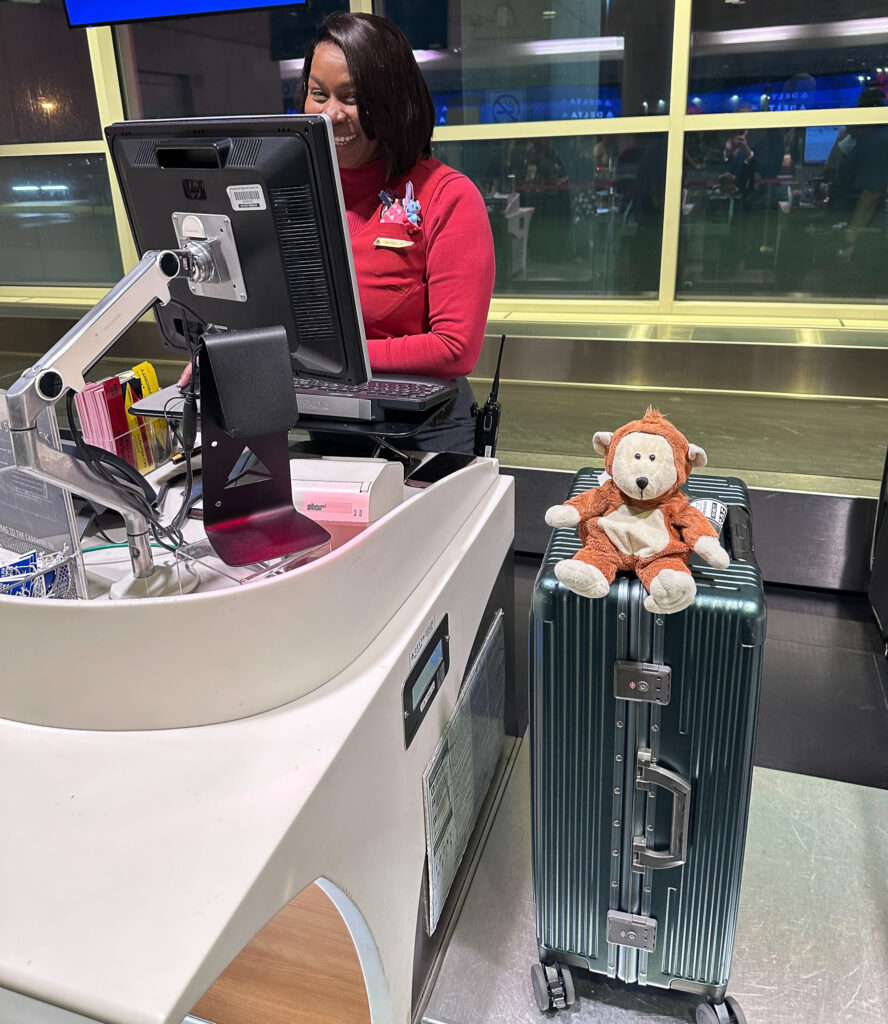 That was enough for me. I switched to Nobl luggage, and I haven’t looked back.
Nobl makes hard-sided luggage with no exposed zippers — instead, the case closes with secure locking tabs that cannot be popped open with a pen or a finger. The hard shell protects your contents from impact, and the construction is genuinely durable. I own three pieces — the small carry-on, the medium wheeled, and the large wheeled — and despite some demanding travel conditions, they’ve held up beautifully. Nobl’s customer service has also been exceptional in the one instance I needed them, which I’ll get to shortly.
One design feature I particularly appreciate: one half of each Nobl case is a fully open compartment, while the other half has a zippered enclosure. This makes organization intuitive and keeps delicate items separated from everything else.
Nobl luggage is expensive. It is absolutely worth it.
A Hard Lesson From the Cobblestones of Lisbon
Speaking of Nobl — let me tell you about Lisbon in April.
It was my first trip to Portugal, and I made a classic rookie mistake: I didn’t know what to expect from the weather, so I packed for every contingency. I loaded up my large wheeled Nobl suitcase, which was heavy. Very heavy.

What I had not adequately prepared for was Lisbon’s famous cobblestone streets — beautiful, historic, and absolutely merciless on wheeled luggage. Rolling a heavy suitcase from the hotel to the Lisbon train station over those cobblestones was a genuine ordeal. Somewhere along the way, one of the wheels gave out — the combined weight and the constant bumping over uneven stone was simply too much.
It got worse. When we reached the train station and boarded for Albufeira, that large, heavy suitcase had to go up the steep boarding steps of the train. It was a real struggle.
Nobl, to their credit, sent me a replacement wheel when I got home. But the lesson was learned — and it cost me a very uncomfortable day to learn it.
For international travel, I now use the medium wheeled suitcase exclusively. It holds more than you’d think, it’s manageable on cobblestones and train steps, and it forces you to pack only what you actually need. Which, it turns out, is less than you think.
Never Lose Your Bag Again: The Case for an AirTag
There is one small item I never pack without, and it costs less than forty dollars: an Apple AirTag.
I keep mine inside my checked luggage, looped around the interior strap that holds the contents down. It stays hidden, protected, and most importantly — always connected. An AirTag uses Apple’s Find My network to report its location in real time, which means that wherever your bag is, you can see it on your phone.
I know this works because I needed it to work.
Two years ago, returning from England via Paris and Atlanta to Louisville, my bag went missing on the final leg. I had collected it at Atlanta’s international arrivals hall, cleared customs, and handed it to the Delta agent to check through to Louisville. Standard procedure. When I landed in Louisville, my bag was not on the carousel.
I went to the baggage claim agent and explained the situation. She tried to locate the bag in Delta’s system but couldn’t get a current location. I then opened my phone, pulled up the Find My app, and showed her exactly where my bag was — still sitting at Hartsfield-Jackson Airport in Atlanta. She now had a precise starting point to track it down, and my bag was eventually located and delivered.
Without the AirTag, that conversation goes very differently. The agent has a missing bag report and a vague hope. With the AirTag, she has a location. That’s the difference between a bag that gets found and a bag that doesn’t.
A few practical notes on AirTags for travelers.
They run on a standard CR2032 coin battery that lasts approximately one year. If it has been several months since your last trip, replace the battery before you travel — a dead AirTag is no AirTag at all. I always put a fresh battery in mine if there’s any question about how long it’s been. It takes thirty seconds and costs almost nothing.
AirTags work best within the Apple ecosystem, so iPhone users get the full experience. Android users can detect a nearby AirTag using NFC, but real-time tracking requires an Apple device. If you travel with an iPhone, there is simply no reason not to have one in every checked bag.
Carry-On vs. Checked Bag: Making the Right Call
The great debate of modern travel. Here’s my honest take.
For shorter international trips of up to a week, a carry-on only approach is achievable if you pack deliberately. The advantages are significant — no baggage fees, no waiting at the carousel, no risk of your bag going to a different city than you did, and the freedom to move quickly through the airport.
For trips of a week or more, or any trip where you need to dress well — suits, sport coats, dress shirts — a single checked bag is the right call. Trying to fit formal clothing into a carry-on without wrinkling it is a losing battle.
My personal approach for international trips is one checked medium bag plus a personal item carry-on. That combination covers everything I need for trips of up to two weeks without excess.
Packing a Suit — and Why a Steamer Is Non-Negotiable
Since I travel in a suit, packing for a professional conference is something I’ve thought about carefully.
The good news is that because I wear a suit on the plane, I don’t need to pack one. That eliminates the biggest formal clothing challenge immediately.
 What I do pack are sport coats and dress shirts, which live in the zippered half of my Nobl case where they’re protected and organized. For a sport coat, folding it inside-out along the natural seams and placing it on top of the contents — not compressed under anything — helps maintain its shape.
But here’s the item I never travel without, and that I recommend without reservation: a portable travel steamer. Most hotels provide an iron and ironing board, and I use them for shirts and trousers. But a steamer is essential for a sport coat — irons can damage the fabric and construction of a jacket, while a steamer gently relaxes wrinkles without direct heat contact.
More importantly, hotels don’t always have irons. On a trip to Lisbon, I checked into a perfectly nice hotel and asked for an iron and ironing board. They didn’t have one. For someone who irons his shirts before wearing them — including the French cuffs — this was a problem. My travel steamer solved it completely. I used it not only to remove wrinkles from the jacket but to crisp up those French cuffs in a way that was entirely satisfactory. It saved the day, and it has never left my packing list since.
A compact travel steamer takes up minimal space, weighs very little, and is worth ten times its cost the first time a hotel doesn’t have an iron.
What to Leave at Home
This is where most travelers go wrong. Overpacking is almost never about forgetting the packing list — it’s about failing to edit it.
Two Days Out: The Clothing Layout Method
Here is the single most effective packing tip I can offer, and it costs nothing but a little time.
 Two days before any international trip — and my international trips are always at least eight days — I lay out or hang up every item of clothing I’m planning to bring. Everything. Then I look at it all together and force myself to cut it in half.
It sounds brutal. It works every time.
This exercise makes overpacking visible in a way that a packing list simply doesn’t. When you see fourteen items hanging on a rail and realize your suitcase holds seven, the editing decisions become much easier. What you’re left with is what you actually need — clothes that work together, that can be layered, and that earn their place by being worn more than once.
Don’t Worry What Others Think
And here’s the thing: you’re visiting somewhere you may not be back to for years. Nobody there knows what you wore yesterday. Nobody is keeping score. The locals aren’t judging your outfit choices and your fellow travelers are too busy enjoying themselves to notice. Wear the same shirt twice. Layer the same sport coat three different ways. It’s your vacation — wear what makes you comfortable and spend your energy on the trip itself, not the luggage.
That philosophy, by the way, is exactly why I wear a suit when I travel. Not to make a presentation, not to impress anyone — but because I feel comfortable in a suit. That comfort is personal and it’s mine. Yours might look completely different, and that’s exactly how it should be. What matters is that your clothes work for you, fit in your bag, and look presentable when they need to.
A suit, however, should look nice and not wrinkled — that much I will insist on. Which is why the steamer is non-negotiable.
What to Leave
After you’ve done the layout and cut it in half, apply these questions to whatever remains:
Will I wear this more than once? If not, leave it. Every item of clothing should earn its place by being worn at least twice.
Can I buy it there if I need it? Toiletries, sunscreen, basic medications — these are available at pharmacies and supermarkets virtually everywhere. You don’t need to bring a month’s supply of shampoo.
Am I packing it just in case? “Just in case” thinking is the enemy of smart packing. Pack for what you will actually do, not for every possible scenario.
Does it serve double duty? A navy sport coat dresses up or down. A scarf works on cool evenings and on air-conditioned planes. Items that serve multiple purposes earn their place; items that serve one narrow purpose usually don’t.
Shoes: Pack Smart, Pack Two Pairs — and Use Them as Storage
Shoes are the heaviest, bulkiest items in any suitcase, so be ruthless. Two pairs maximum — and wear the heaviest pair on the plane.
I wear cowboy boots with my suit when I travel. They are large, heavy, and are absolutely not everyone’s cup of tea — but they are mine, and comfort on a long journey matters. They go on my feet for the flight, which keeps them out of the suitcase entirely.
Inside the suitcase I pack two additional pairs: one for walking and covering ground during the day, and one for evenings out — restaurants, clubs, or anywhere that calls for something a little sharper.
Here is a packing trick that serves me well on every trip: use the inside of each shoe as storage space. Shoes have a surprising amount of room inside them. Items placed there stay protected and don’t get tossed around the way they would loose in the suitcase. I use mine for watches and more delicate items that I want to keep safe and stationary during transit. Roll a pair of socks inside each shoe first to help it hold its shape, then tuck your valuables in alongside. Nothing shifts, nothing gets scratched, and you’ve used space that would otherwise be completely wasted.
Toiletries and the TSA 3-1-1 Rule
If you’re carrying toiletries in your carry-on, you need to know the TSA 3-1-1 rule — and follow it without exception, or risk having items confiscated at security.
The rule is straightforward: you are allowed to bring a quart-sized bag of liquids, aerosols, gels, creams and pastes through the checkpoint, limited to 3.4 ounces (100 milliliters) or less per item. The name comes from the three components: 3.4 oz per container, 1 quart-sized clear bag, 1 bag per passenger.
If an item spreads, squeezes, smears, sprays, or pours, it counts as a liquid under TSA regulations. This includes toothpaste, lip balm, moisturizer, sunscreen, hair gel, and deodorant spray — items travelers frequently forget are subject to the rule.
Prescription liquid medications are exempt from the 3-1-1 rule, but should be declared to TSA officers at the checkpoint and kept in their original labeled packaging. Carry a copy of your prescription for international travel.
A few practical tips: buy travel-sized versions of your essential toiletries before you leave, or transfer them into reusable travel bottles. Place your 3-1-1 bag at the top of your carry-on so it’s immediately accessible at security — don’t bury it at the bottom. And if you’re checking a bag, put your full-sized toiletries in there and skip the 3-1-1 bag entirely.
One welcome update worth noting: as of July 2025, TSA announced that passengers can now keep their shoes on during screening at participating airports— one less thing to manage at the security checkpoint.
Ziplock Bags
One more toiletry tip that has saved me more than once: always pack liquids in ziplock bags, even in your checked luggage — especially cologne, lotion, and shampoo.
Most hotels provide the basics, but not all do. I always travel with my own cologne, a lotion suited to my skin type, and sometimes shampoo. These go in checked baggage since they exceed the TSA 3-1-1 size limits. The problem is that bottles get jostled in transit, and lids and tops have a way of working themselves loose at the worst possible moment.
My cologne fits neatly in a sandwich-sized ziplock bag, which then goes inside one of my shoes for an extra layer of protection and to keep it from moving around. Lotion and shampoo bottles go into a quart or gallon-sized ziplock depending on the size. On more than one occasion, the lid on my lotion bottle has come off completely during a flight. The only mess was inside the ziplock bag — not on my clothes, not on my suit, not on anything that mattered. The bag contained it entirely.
Ziplock bags cost almost nothing and take up no space. Use them for every liquid in your checked bag, every single trip. You will thank yourself the first time a lid comes loose at 35,000 feet.
Packing for Different Climates
International travel often means unpredictable weather, and the temptation is to pack for every possibility. Resist it.
Research the typical weather for your destination during the specific dates of your trip — not the seasonal average, but the actual forecast range for that time of year. Apps like Weather.com and local meteorological sites give you reliable two-week forecasts.
Build your wardrobe around layers rather than bulk. A lightweight merino wool base layer, a dress shirt, and a sport coat covers you from a warm afternoon to a cool evening without taking up much space. Merino wool in particular is a traveler’s best friend — it’s temperature-regulating, odor-resistant, wrinkle-resistant, and looks presentable in almost any setting.
For trips that span multiple climates — say, a few days in London followed by the south of Portugal — pack for the coldest conditions and plan to shed layers as needed. It’s easier to remove a layer than to wish you had brought one.
Don’t Forget Your Power: Voltage Converters and Outlet Adapters
Here is something that catches many first-time international travelers completely off guard: the rest of the world does not use the same electrical outlets or voltage as the United States.
The U.S. runs on 110 volts. Most of Europe — including England, France, and Portugal — runs on 220 volts. Plug an American appliance directly into a European outlet without a voltage converter and you will, at best, damage the appliance and, at worst, create a safety hazard. Beyond the voltage difference, outlet shapes vary significantly from country to country. The UK uses a distinctive three-pronged rectangular plug, France and Portugal use a two-pronged round plug, and other countries have their own variations entirely.
My solution is simple and has never failed me. I keep a small dedicated bag — compact enough to fit inside my carry-on — that contains two things: a voltage converter that steps 220 volts down to 110, and a set of outlet adapters for different countries. Before any international trip I pull out the bag, confirm I have the right adapter for my destination, and pack it in my carry-on.
That last point is important. The voltage converter and adapters go in the carry-on, not in checked luggage. This is not an item I am willing to risk losing with a checked bag. Without it, my steamer is useless, my phone charger may not work properly, and any other American appliance I’ve brought becomes a paperweight.
Shopping Notes
A few things worth knowing when shopping for a converter and adapters. Many modern electronics — laptops, phone chargers, and some travel steamers — are dual voltage, meaning they handle both 110 and 220 volts automatically. Check the label on your device’s power brick; if it says “100-240V” you only need an adapter for the outlet shape, not a full voltage converter. However, appliances like a single-voltage steamer or hair dryer will need the full converter.
A quality travel adapter set with a built-in converter is a one-time purchase that will serve you for years of international travel. Buy a good one, keep it in its dedicated bag, and always pack it in your carry-on. It is one of those small items that makes an enormous difference the moment you arrive in your hotel room and need to press your shirt for dinner.
A Final Packing Checklist
Before you zip up the bag, run through these:
- Every clothing item will be worn at least twice
- One pair of shoes for walking, one for evenings — worn on the plane
- Travel steamer packed in the open compartment
- 3-1-1 toiletry bag at the top of the carry-on
- Prescription medications in carry-on, not checked luggage
- Passport, travel insurance documents, and itinerary in your personal item
- Luggage tagged inside and out
- Bag weight checked — most international airlines allow 50 lbs for checked bags
- Voltage converter and country-specific outlet adapters packed in carry-on
And the most important item on the list: if you’re not sure you need it, leave it behind. The cobblestones of Lisbon have a way of making overpacking feel very personal very quickly.

Buddy and Jordan
Have a packing tip that has saved you on a trip? Share it in the comments below. And for more practical travel advice, join our newsletter — new posts every week.